Objects of desire: Tom Dixons Pose Portable light

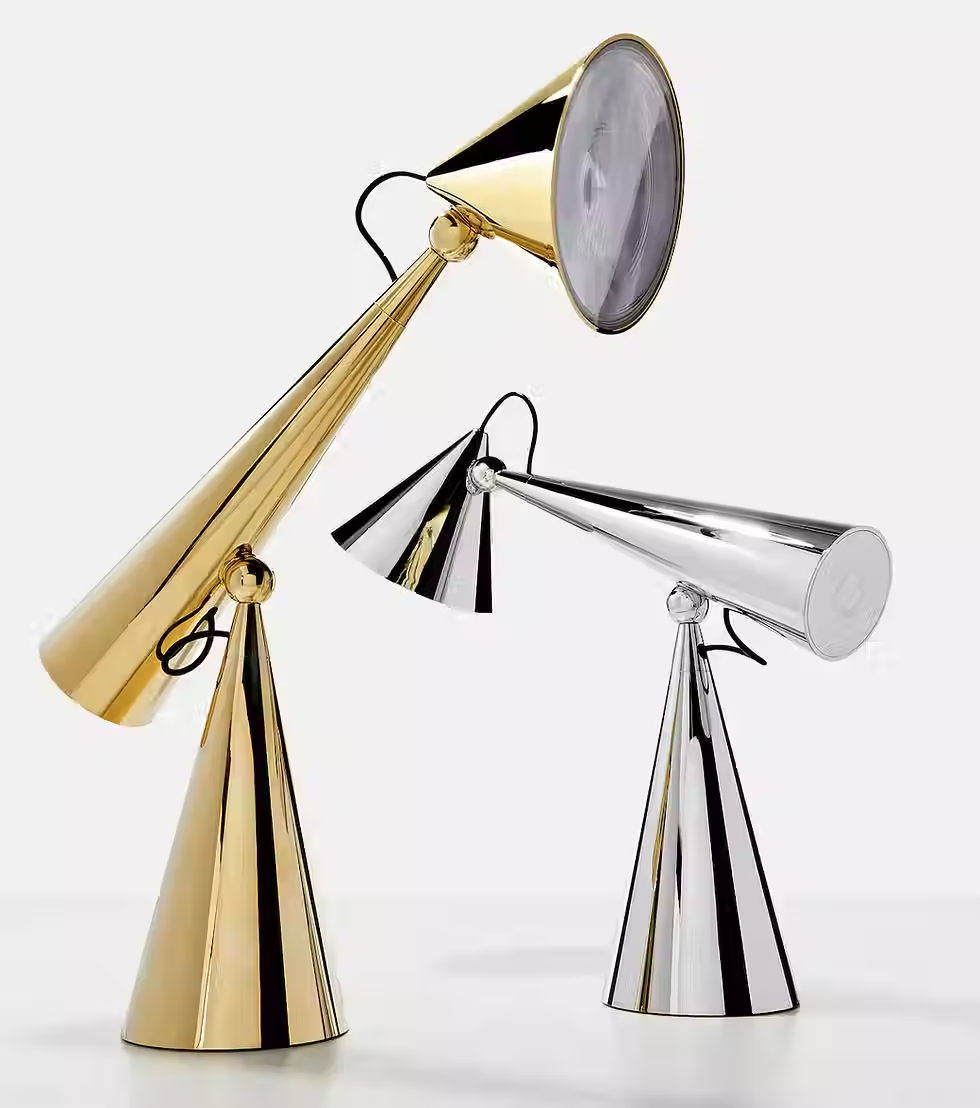
With a strong silhouette and a touch of humour, Pose Portable manipulates light into focused, magnified beams with striking effect. It is a high output task lamp based on conical forms that playfully explores the world of optical physics, through the world of flat lenses -often seen in lighthouses. With anthropomorphic charm, Pose manipulates light into focused, magnified beams with striking effect. A strong silhouette and touch of humour define its personality, while precise adjustability and high light output ensures adaptability and functionality for any space— domestic or contract.

Designed in 2023 in our London Studio, POSE focuses light through a flat Fresnel Lens, used in lighthouses, medical and scientific applications, creating a precise, magnified beam. The POSE Portable was created through stacking of conical forms into a visually pleasing combination. Inspired by the beauty of a static moment, its posture gives it an almost human presence.
Fully serviceable with spare parts to extend the products life, the POSE is also equipped with a switchable colour temperature 3W LED that can deliver both 3000K or a warmer 2700K at full brightness. Featuring a high-quality rechargeable battery and magnetic charging cable, it delivers 6–10 hours of concentrated lighting, magnified through a custom lens into an illuminating beam.
Versatile & Dynamic
Rechargeable, dimmable and with the ability to switch colour temperature, POSE Portable is available in a range of colours and metallics and as a larger more powerful Task Light. Versatile and dynamic, adds an extra layer of functionality into cordless lighting, through its fully adjustable shade and concentrating lens it can illuminate the darkest corner of a space.
About the designer Tom Dixon
Born in Tunisia, Tom Dixon moved to England in 1963. His restless and rebellious nature led him to abandon his studies at the Chelsea School of Art so that he could explore his own creativity and a personal means of expression using recycled materials. In those years, he opened the laboratory “Space”: a think tank, an independent open space where artists and designers could collaborate together and influence each other creatively and design-wise.
Tom Dixon is a rare bird in the design panorama. He didn’t study design or architecture or follow a classical training, he has music and rock – and motorbikes – in his blood. He doesn’t design for other companies and brands, quite unusual in the industry, but has made his own name into a brand and a company, doing things his own way. Disco and motorbikes… that’s how it all got started.
“In the late 70s I was a musician, I used to play a bit of bass guitar, but it was more disco than punk, and then I had an accident with my motorbike, I broke my arm… I crashed into a car… I couldn’t play for a while, so I started making things and that became my job!”, Dixon told in the interview for the Luisa Via Roma.
It was during this fertile period that Tom Dixon began

collaborating with Cappellini, for whom he created the iconic S-Chair. In the 1990s, “Space” was transformed into a full-fledged design studio: Dixon became recognized as a top-level designer and his name started spreading rapidly amongst internationally acclaimed brands.
His success in the commercial field resulted in his appointment as Head of Design at Habitat in 1998, where he took on the role of Creative Director.
Simultaneously, he engaged in private and institutional collaborations, committing himself to several significant projects and producing a series of pieces that are set to remain unmatched in popularity and acclaim.
In 2000, designer was honored with the Order of the British Empire, bestowed by HRH Queen Elizabeth II. Dixon’s creations are part of the permanent collections of prominent museums, such as the Victoria & Albert Museum, the MoMa in New York and Tokyo, and the Centre Pompidou.


Comments